La Carpio Shows Signs of Change After Years Marked by Poverty
Years ago the name La Carpio stood for extreme poverty, homes made of corregated metal and recycled wood, and high crime. That’s all changed. The area, to the west of Hospital Mexico and Parque de Diversiones in San Jose, is still considered to be poor but shows signs of an active economic life with little shops offering all kinds of goods; food stands, auto repairs, clothes and restaurants.
Cars, motorcycles and buses cross the area. Homes are now made of concrete blocs and cement. About 35,000 people inhabit 23 square kilometers in what was once an empty field owned by the government. La Carpio began with squatters, mostly Nicaraguan, seeking homes away from the violence, the war, the poverty, and the uncertainty of their country.
On a recent visit to the Humanitarian Foundation, a non-profit which has been instrumental in helping raise La Carpio from extreme poverty, we saw nicely dressed people, everyone busy with work or errands. Children looked healthy and clean as they played in the streets or accompanied parents. Even the dogs, and there were many, looked well fed and cared for. A report from the OIJ recognized that the district is still high crime but it is going down and it’s a lot safer than many other areas of San Jose. La Carpio is part of the district of Uruca.
In 2018 a new, modern grade school was built to accomodate La Carpio’s children with room for pre kindergarden, special education, and a library. A technical high school in Tibás serves for secondary studies. Police patrols are now visible.
Many of the benefits are the results of projects by the Humanitarian Foundation and its founder, Gail Nystrom. The foundation began 1993 as a means “to provide economic solutions to social challenges”, says Nystrom who first came to Costa Rica with the Peace Corps in 1978. “I was 13 years old when I first heard about the Peace Corps founded by President Kennedy. I decided then that that’s what I wanted. To help poor people.” After graduating from the University of Virginia and earning a master’s in special education from the University of Denver she signed up
She had not planned on Costa Rica, an almost unknown country back then. Her first role here was visiting schools to work with their programs. Later she lived and taught in Talamanca in schools that lacked almost everything. Helping people had been her goal. When her two years were up she returned to the states, but she knew she would return here. “How could I leave these people?” She came back. And stayed.
“I saw children living on the street,” she said of her first experience. She invited them to her home to learn about their situation and try to help. In the 45 years since she moved back she and the foundation have been a positive influence, starting projects and groups. 50,000 bunk beds so kids don’t have to sleep on floors and to help prevent sexual abuse, food programs, day care and after school programs, lunch programs, educational activities with games and play, woodwork projects, a soccer league with 120 players, dance groups, break dance for teens, summer camp, health fairs and more. Volunteers come from around the world to learn and to help
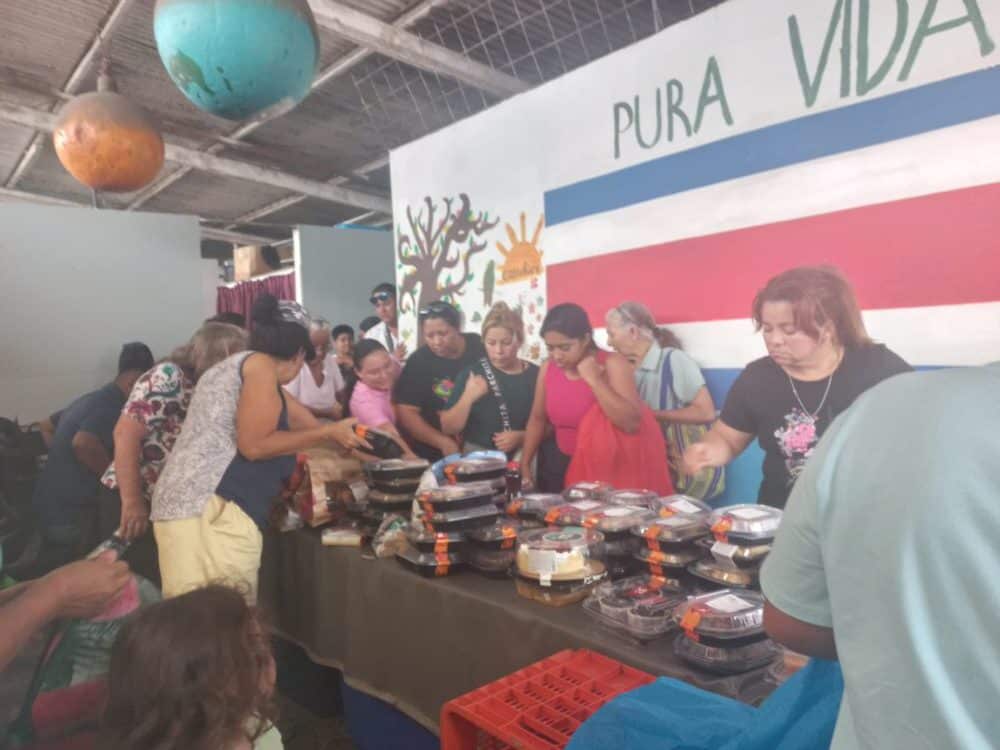
La Carpio is no longer known for its poverty but many residents still rely on help. A kitchen program is now independent of the foundation and employs more than a dozen residents while providing food for many. The grocery chain Auto Mercado sends all the food that has reached the expiration date to the foundation’s center where women and men sort, bag, set out, tabulate, and sell the donated products, and customers wait to select vegetables, fruit, bread and rolls, and something for dessert. This is no charity. The people “buy” the food albeit low cost. The money goes to pay all the workers and their social security. It helps both ways. Many are single mothers, Nystrom explained.
While we were there a woman came to the foundation asking for help to bury a nephew. A young man who had lost a leg and suffered severe injuries in a work accident told us how Nystrom helped him through a painful year of recovery. There are many stories of how Gail and the foundation have helped in La Carpio.
“This is the third generation,” Nystrom explained. “They are Costa Rican. “They were born here. They’ve gone to school here. They have more choices” La Carpio has improved a lot since their parents and grandparents settled in as squatters. It’s safe here now, but there are some areas that are still high risk and Nystrom fears that narco gangs could come in. That’s a fear shared by many Costa Ricans. For now La Carpio, once a slum, provides a better quality of life for it’s 35,000 residents.
Look for infomation on the Humanitarian Foundation at www.crhf.org.
The post La Carpio Shows Signs of Change After Years Marked by Poverty appeared first on The Tico Times | Costa Rica News | Travel | Real Estate.

Comments
Post a Comment